
'Rhetoric and chest-thumping are running high on India's recent growth record.'
'But will the giant waves developing elsewhere allow us to sail smoothly into fair winds?' asks Debashis Basu.

India is likely to grow by 7.5 per cent in the first quarter of the current financial year, driven by rising aggregate demand and non-food spending in the rural economy, according to an article in the RBI's May Bulletin released on Tuesday. The Indian economy has demonstrated marked resilience in the face of geopolitical headwinds impacting the supply chain, said an article on the state of the economy published in the May Bulletin.

Prime Minister Narendra Modi on Saturday vowed to thwart alleged attempts to rob Dalits and backward classes of reservations by the Indian National Developmental Inclusive Alliance (INDIA) which he accused of 'enslavement' and performing 'mujra' for Muslim vote bank.

Growth rate in per capita income is projected to fall to the lowest in 21 years this financial year - except for the financial years 2019-20 (FY20) and 2020-21 (FY21) - according to the first advance estimates. During the last 21 years, the two periods - FY20 and FY21 - saw growth rates in per capita income lower than 7.9 per cent, seen during FY24. This was despite the real gross domestic product (GDP) being projected to grow by 7.3 per cent in the current financial year by the first advance estimates.

The WPI has been in the negative zone since November.

The Interim Budget for 2024-25 (FY25) to be presented on February 1 is likely to assume 10-10.5 per cent nominal gross domestic product (GDP) growth against 8.9 per cent estimated for FY24 by the National Statistical Office (NSO). "We were waiting for the First Advance Estimates GDP numbers for FY24. "We will finalise the nominal GDP growth assumption for FY25 Interim Budget in a couple of days.

A careful reading of the national income accounts suggests that after a strong recovery from the pandemic, there has been a significant ebbing of dynamism over the last three quarters to more modest levels recently, note Arvind Subramanian and Josh Felman.

'If you look at where inflation (headline and core) is today in India and where the rates are, there's clearly room to cut rates.'

Wholesale inflation fell to a 3-month low of 2.04 per cent in July on decline in prices of food items especially vegetables, government data released on Wednesday showed. The decline in wholesale price index (WPI) based inflation in July came after it rose for four months in a row till June, when it was 3.36 per cent. It was (-) 1.23 per cent in July last year. In April wholesale inflation stood at 1.19 per cent.
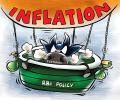
The Reserve Bank of India on Friday retained its projection for retail inflation at 4.5 per cent for the current fiscal assuming a normal monsoon, while emphasising that uncertainties related to food price outlook warrant a close monitoring. Consumer Price Index (CPI)-based retail inflation has been projected at 4.5 per cent with quarter-wise projections at 4.9 per cent in Q1 (April-June), 3.8 per cent in Q2, 4.6 per cent in Q3, and 4.5 per cent in Q4.

The official said that the National Statistical Commission (NSC) is examining the working group report on the roadmap for introducing the PPI and their recommendations are awaited. "It is with Statistical Commission, so we will wait for the panel recommendation," the official, who did not wish to be named, said.

The Reserve Bank of India's (RBI's) state of the economy report observed that any durable alignment of headline retail inflation with the target of 4 per cent could recommence in the second half of FY25 and sustain until numbers closer to the target are seen during the course of FY26, dashing hopes of any reduction in the policy repo rate in the current financial year. The report, authored by RBI staffers, including Deputy Governor in charge of monetary policy Michael Patra, said though headline numbers may fall in July and August due to base effect, it is likely to reverse in September.

Wholesale inflation rate declined marginally to 0.2 per cent in February compared to 0.27 per cent in the preceding month despite a slight uptick in the food basket. The Wholesale Price Index (WPI)-based inflation was in the negative zone from April to October and had turned positive in November at 0.26 per cent. The inflation in February 2023 was 3.85 per cent.

Afghanistan, Australia and Bangladesh are in the running for a place in the T20 World Cup semi-finals.

USA's sparkling debut, Afghan bravehearts' dream run and India's brilliance

'Revision of the base year for both CPI and GDP are long overdue.' 'The basic data that went into the 2011-2012 series were mainly from surveys done in 2011 or earlier.' 'We have since seen the emergence of new sectors like platform-based work and online marketing.' 'The employment surveys and the consumption surveys need to reflect these adequately.'

US's terrible political and economic leadership will ultimately cost the dollar its value. India must act early to avoid being dragged down, suggests R Jagannathan.

How is it that tomatoes recorded a price fall in official statistics when it remained unaffordable for the common person in June?

If Hindenburg or its partner do not join the investigation, then Sebi may pass an ex-parte order against it, which may be enforced as a foreign award in US courts.

I am happy I didn't knock anyone down, driving recklessly or trying to show off. However, in one instance of road rage (the consequence of arguing with a driver who disrespected my right to cross the road peacefully) I did find a man in a SUV taking his anger out on me by driving his vehicle over my feet, recalls Shyam G Menon.

Union Finance Minister Nirmala Sitharaman, along with her team of bureaucrats, delved into the fine print of the 2024-25 Budget documents in a press conference, detailing the government's road map on bringing down the debt-to-GDP ratio and bold tax measures.
Retail inflation eased to an 11-month low of 4.83 per cent in April as prices of some kitchen items declined though overall food basket firmed up marginally, according to a government data released on Monday. The Consumer Price Index (CPI)-based retail inflation was 4.85 per cent in March. It was 4.7 per cent in April 2023.

Images from Day 3 in the first Test between South Africa and India, at SuperSports Park, Centurion, on Thursday.

Despite the upbeat statement, the party is expected to reflect on what caused the sharp fall in its numbers. It is expected to win about 240 seats against the 303 it had won in 2019.

Global fund managers remain bullish on the Japanese stock markets, which is now their most preferred destination in the Asian region. Both Morgan Stanley and Jefferies in their recent reports, have cited their preference for the Land Of The Rising Sun, which is fast becoming the land of the rising equities, too.
Domestic rating agency Icra on Monday revised its FY24 GDP growth forecast to 6.5 per cent from 6.2 per cent earlier. However, the revised forecast is still much lower than the Reserve Bank of India's (RBI's) 7 per cent real Gross Domestic Product (GDP) growth estimate for the ongoing fiscal. Earlier this month, the RBI had revised upwards its GDP estimate to 7 per cent from 6.5 per cent, calling the revised number a "conservative" one.

Rohit's men start overwhelming favourites but Shaheen, rain pose threat

The ongoing Hamas-Israel conflict has disrupted India's efforts to gain from a recent fall in crude oil prices. Since Hamas' invasion of southern Israel on October 7, petroleum has become costlier by around $5 per barrel, threatening to stoke prices and impact growth. Brent crude was trading at $89.8 per barrel on October 9 (9.15 pm IST), up over 4 per cent, thwarting India's anticipation of a period of declining oil prices - after the leading global petroleum benchmark declined by around 11 per cent last week.

Opener Ben Duckett smashed an 88-ball hundred to lead England's robust reply to India's first innings total of 445 on day two of the third Test in Rajkot on Friday.

India would be thoroughly justified in thinking their misfiring opening pair have let them down.

The lack of runs from their Indian batters -- Prithvi Shaw (106 runs in 8 matches), Manish Pandey (160 runs in 10 games), Sarfaraz Khan (53 runs in 4 games) and Lalit Yadav (66 runs from six games) -- proved a big factor in another below-par season for Delhi Capitals.

Unemployment has been rising among the young, with authorities suspending data disclosures after youth unemployment crossed 20 per cent.

Tammy Beaumont and Nat Sciver's aggressive unbeaten fifties beat India Women by eight wickets

The Indian economy is likely to post better than anticipated growth in the second quarter (July-September) owing to robust urban consumption and expansion in services, a Business Standard analysis of high-frequency indicators showed. While gross domestic product growth in the September quarter is expected to come below the 7.8 per cent print in the June quarter due to a favourable base fading, analysts say the print will be much closer to 7 per cent than the 6.5 per cent anticipated earlier. While the Reserve Bank of India (RBI) had estimated 6.5 per cent growth for July-September, last month Governor Shaktikanta Das said the growth figure would surprise on the upside.

Shreyas Iyer slammed 178, while captain Siddhesh Lad made a responsible 130, to power Mumbai to an imposing score of 439 for eight against Baroda, on Day 1 of the Ranji Trophy match.

The government has exhausted only 39 per cent of its fiscal deficit target in the first half of FY24.

England will have to set a record for the highest successful fourth-innings chase if they are to win the third Test against India after the dominant tourists declared at 352 for seven with Virat Kohli making 103.

A round-up of the Ranji Trophy quarter-final matches played on Monday.

Despite multiple headwinds at the start of 2023, the Indian markets delivered a strong performance, posting 19-20 per cent growth for the year. Even as new records were set, investor sentiment remains strong going into 2024, given the lower inflation, expectations of steady to lower interest rates, higher economic growth, and strong inflows. However, the overriding concern for most brokerages is valuations.
'How low GDP would have been, we don't know.' 'It raises serious questions because so many indicators are pointing to such a sharp decline and GDP estimates are still showing 4 per cent growth.'
 © 2026 Rediff.com - Advertise with us - Disclaimer - Privacy Policy - Sitemap - Feedback - About us - Terms of use - Grievances